When Rockstar Games released the initial trailer for Grand Theft Auto VI, it set the entire entertainment industry ablaze. Beyond the stunning visuals and new characters, the biggest point of discussion among fans was the setting. GTA 6 takes players back to the neon-soaked streets of Vice City and the broader state of Leonida. Since GTA V’s fictional state of San Andreas has been the playground for gamers since 2013, comparing the two virtual worlds is natural.
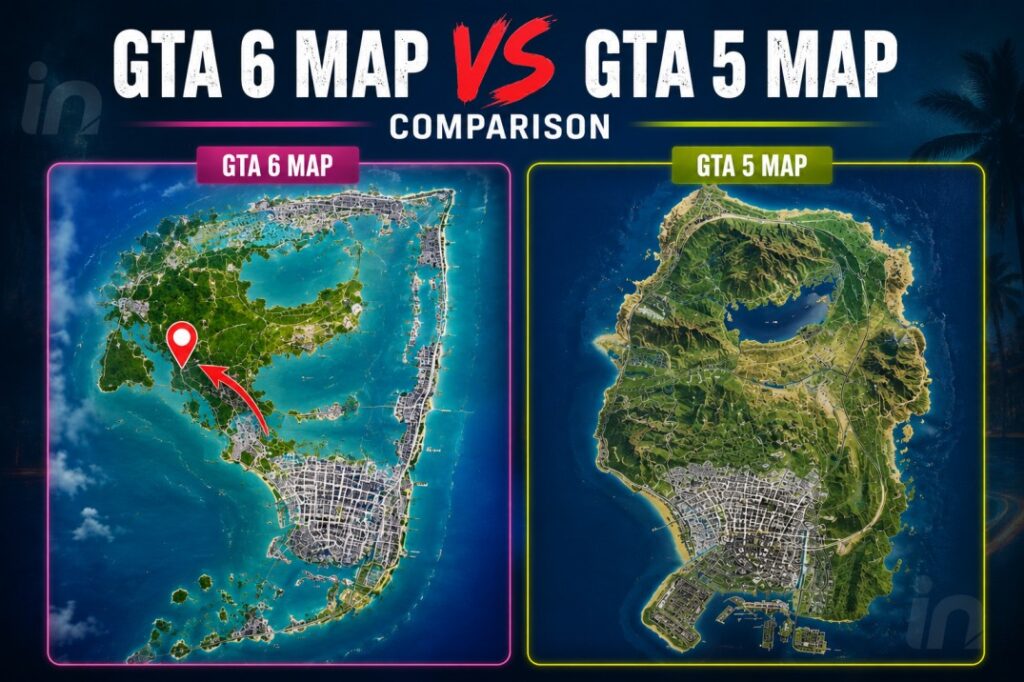
In this comprehensive analysis, we will examine the gta 6 map vs gta 5 map in terms of overall size, geographical diversity, town density, enterable structures, and the unique gameplay tasks and challenges players will face across these massive virtual environments.
Map Size and Scale Comparison
The most common question gamers ask is how the overall landmass compares between the two titles.
The GTA 5 Map: San Andreas
The map of GTA V is set in the state of San Andreas, which consists of the metropolitan city of Los Santos and the rural Blaine County. Geographically, the map is an island surrounded by ocean. The total area of the GTA 5 map is approximately 75 square kilometers (about 29 square miles). While massive for its time, a large portion of the northern map consists of uninhabited mountains (Mount Chiliad) and empty desert regions, which some players felt reduced the usable space.
The GTA 6 Map: Leonida
The setting of GTA 6 is the state of Leonida, which is Rockstar’s fictionalized version of Florida. Rather than focusing on a single city, Leonida represents a massive state-wide environment.
Based on measurements from official trailer footage and community mapping projects that analyze the coordinates of in-game landmarks, the GTA 6 map is projected to be more than double the size of the GTA 5 map. Estimates suggest the total landmass could exceed 150 square kilometers, offering a much larger, continuous world to explore.
Locations and Cities: Vice City vs Los Santos
The contrast in setting between the West Coast-inspired San Andreas and the East Coast-inspired Leonida creates two completely different atmospheres.
Los Santos (GTA 5)
Los Santos was designed to replicate Southern California, featuring sandy beaches (Vespucci Beach), high-end retail districts (Rockford Hills), and dry, dusty deserts (Sandy Shores). The environment is characterized by large elevation changes, with major mountain ranges splitting the northern and southern halves of the map.
Vice City and Leonida (GTA 6)
Leonida is characterized by a flatter, tropical landscape. The map features several distinct urban hubs and natural regions:
- Vice City: The main metropolitan area, based on Miami, featuring bright neon lights, towering skyscrapers, and busy beachfronts.
- Port Gellhorn: A secondary major city located in the western portion of the state, serving as a suburban and industrial hub.
- The Keys (Gator Keys): A chain of small islands connected by long overseas highways, requiring players to travel across water to navigate the southern edge of the map.
- The Grasslands: A massive swamp and wetland region based on the Florida Everglades, home to diverse wildlife and remote communities.
To fully explore this massive new map, players will be switching between the two main GTA 6 characters Lucia and Jason to complete missions and heists.
Environmental Density and Enterable Buildings
While size is important, map density—how much there is to see and do in a given space—is what makes a virtual world feel alive.
Hollow Structures in GTA 5
One of the limitations of the GTA 5 map was that the vast majority of buildings were static, hollow models. Except for specific safehouses, shops, and mission-specific locations, players could not enter the skyscrapers, residential homes, or commercial warehouses. This meant that while the city looked massive from the outside, the actual playable interior space was relatively small.
Enterable Interiors in GTA 6
For GTA 6, Rockstar Games has focused heavily on interior density. According to official developer announcements and analysis of game engine capabilities, the game features a significant increase in enterable buildings. Players will be able to walk into local restaurants, convenience stores, high-end hotels, apartment complexes, and warehouses. This adds a vertical layer of exploration to the flat Florida-inspired terrain, making the map feel far denser and more interactive than Los Santos.
Gameplay Tasks and Exploration Challenges
The geographical layout of the gta 6 map vs gta 5 map directly influences the gameplay tasks, travel mechanics, and challenges players must navigate.
1. Water-Based Navigation and Marsh Travel
While GTA 5 featured oceans and a few rivers, water travel was mostly optional. In GTA 6’s Leonida, water is a core component of the map. Navigating the Gator Keys and the swampy Grasslands will require players to master airboats, jet skis, and yachts. Exploring these shallow wetlands presents unique environmental hazards, including thick mud that slows down land vehicles and aggressive wildlife like alligators that can attack players in the wild.
2. Next-Generation Dynamic World Events
GTA 5 introduced random world events, such as stopping muggers or helping stranded drivers. GTA 6 upgrades this system with a dynamic world event engine. The map will feature organic, changing scenarios such as beach parties, street racing meets, wildlife crossing roads, and neighborhood disputes. These events do not require players to start a formal mission, making organic exploration of the map feel spontaneous.
3. Vertical Urban Challenges
In the dense skyscrapers of Vice City, players will face new vertical challenges. Heists and escapes will not just be limited to ground-level car chases. Players must navigate multi-story parking structures, rooftop corridors, and elevator shafts, utilizing the high volume of enterable buildings to hide from police helicopters and tactical response teams.
Technical Comparisons: Next-Gen SSD Technology
The technical transition from GTA 5 to GTA 6 represents a massive leap in hardware capabilities.
Built for Consoles of the Past
GTA 5 was originally released in 2013 for the PlayStation 3 and Xbox 360, which relied on slow mechanical hard drives. As a result, the game had to limit drawing distances, traffic density, and asset loading speeds to prevent pop-in textures and loading screens.
Next-Gen Optimization
GTA 6 is built exclusively for the PlayStation 5 and Xbox Series X|S, which utilize high-speed Solid-State Drives (SSDs). This hardware upgrade allows for:
- Zero Loading Screens: Transitioning from the outdoor streets of Vice City to the indoor lobby of a hotel will happen instantly with no loading delay.
- Extreme Drawing Distances: Players standing on top of a Vice City skyscraper will be able to see the lights of distant towns on the horizon clearly.
- Massive Crowd Density: The streets, beaches, and night clubs will feature hundreds of unique NPCs (Non-Player Characters) moving independently, compared to the sparse streets of Los Santos.
FAQs: Frequently Asked Questions
How big is the GTA 6 map compared to the GTA 5 map?
The GTA 6 map, set in the state of Leonida, is projected to be more than double the size of GTA 5’s San Andreas map. The estimated landmass exceeds 150 square kilometers, compared to GTA 5’s 75 square kilometers.
What cities are in the GTA 6 map?
The primary metropolitan city is Vice City, which is based on Miami. The map also features secondary towns like Port Gellhorn, rural farming communities, and the Gator Keys.
Can you enter more buildings in GTA 6?
Yes. Unlike GTA 5, which featured mostly hollow buildings, GTA 6 is designed with a high level of interior density, allowing players to enter a large percentage of commercial and residential buildings across the map.