For football fans looking at the goal-scoring charts, an erling haaland biography reads like a manual on how to design the perfect modern center-forward. Standing at six feet four inches with explosive speed, clinical finishing, and intelligent off-the-ball movement, the Norwegian striker has transformed how teams approach attacking football. He does not play like a traditional target man, nor does he rely solely on pace; instead, he combines raw physical dominance with a hyper-focused lifestyle to achieve historic results on the pitch.
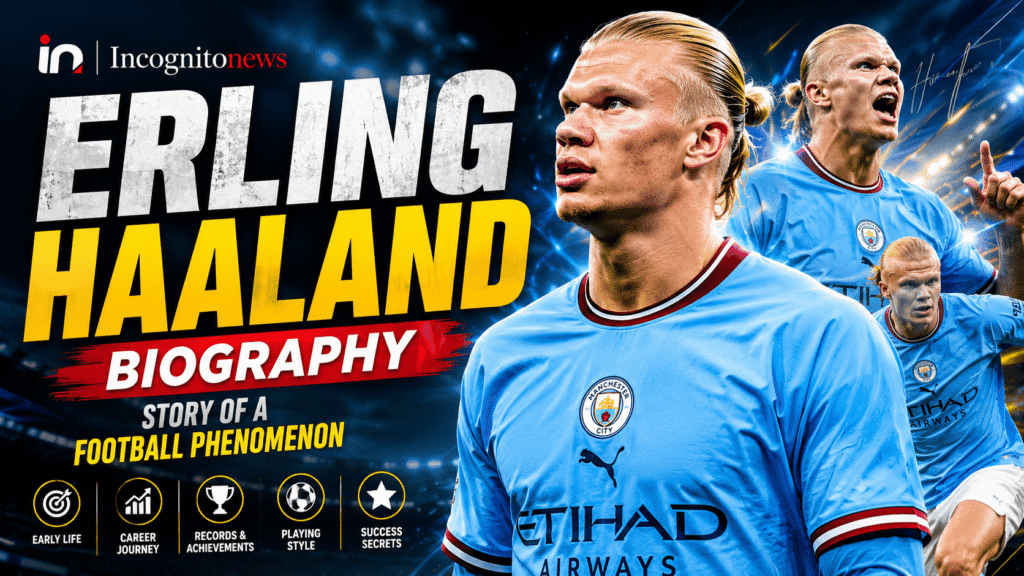
His journey from a small, cold-weather town in Norway to the pinnacle of European club football with Manchester City represents one of the most rapid ascents in modern sports history.
This detailed biography covers his early life in Leeds and Norway, his development through Molde and Salzburg, his German breakthrough, his record-breaking campaigns in England, and the highly calculated lifestyle choices that keep him performing at his peak.
Erling Haaland Biography: Born Into the Game
Erling Braut Haaland was born on 21 July, 2000, in Leeds, England. His birth location was no coincidence; his father, Alf-Inge “Alfie” Haaland, was a professional defender and midfielder playing for Leeds United in the English Premier League at the time. Growing up in a sporting family, athletics were part of his daily life from his earliest memories. His mother, Gry Marita Braut, was an accomplished heptathlete in Norway, ensuring that athletic genes and a competitive mindset were present on both sides of his family tree.
When Erling was just three years old, his father suffered a career-ending injury, prompting the family to relocate back to their hometown of Bryne, a small farming community in southwestern Norway.
In Bryne, the young boy did not focus solely on football. His parents encouraged him to participate in a wide variety of sports to build coordination and prevent physical burnout.
He played handball, golf, and participated in track and field events. In fact, at age five, he set a world record for his age group in the standing long jump, recording a distance of one point sixty-three meters, a record that still stands today. This multi-sport background built the foundation for the unique flexibility, power, and spatial awareness he displays on the football pitch today.
The Bryne and Molde Apprenticeship
Despite his talent in other sports, football was always his primary passion. He joined the youth academy of the local club, Bryne FK, where coaches quickly noticed his relentless drive to score. Unlike many talented youths who rely on physical size, he was actually quite small and thin during his early teenage years. This forced him to develop intelligent movement, timing, and positioning to get past larger defenders.
He made his professional debut for Bryne in the second division of Norwegian football at the age of fifteen, an extraordinarily young age for senior men’s competitive play.
Recognizing his massive potential, Molde FK, one of the top clubs in the Norwegian premier division, signed him in 2017.
At Molde, he came under the guidance of manager Ole Gunnar Solskjaer, the former Manchester United striker legendary for his own clinical finishing. Solskjaer took the young forward under his wing, teaching him the nuances of heading, timing runs in the box, and remaining calm in front of the goalkeeper.
During his two seasons at Molde, his body underwent a massive physical transformation. A significant growth spurt, combined with intense weight training, saw him gain over fifteen kilograms of lean muscle. His teammates began calling him the “Man-Child” because of his ability to overpower senior defenders while maintaining his lightning-fast sprint speeds. His breakthrough performance came in July 2018, when he scored four goals in the first twenty-one minutes of a match against undefeated league leaders Brann, alerting scouts across Europe that a special talent was emerging in the North.
Red Bull Salzburg: The Champions League Explosion
In January 2019, Austrian Bundesliga champions Red Bull Salzburg signed the forward. Salzburg had built a reputation for developing elite young talent, and it proved to be the perfect environment for him to test himself against European competition.
While his first few months were spent adjusting to the team’s high-pressing style, the 2019-2020 season became his official launchpad onto the global stage.
He began the domestic season with consecutive hat-tricks, but it was his debut in the UEFA Champions League in September 2019 that shocked the football world.
Playing against Belgian side Genk, the nineteen-year-old scored a first-half hat-trick in a six to two victory.
He went on to score in his next four consecutive Champions League matches, including goals against Liverpool at Anfield and Napoli. He became the first teenager in history to score in five consecutive matches in Europe’s most prestigious club tournament, finishing the group stage with eight goals in six games. His combination of size, direct running, and infectious joy on the pitch made him the most sought-after signature in the January transfer window.
Borussia Dortmund: Conquering the Bundesliga
In December 2019, German Bundesliga club Borussia Dortmund secured his transfer by triggering his twenty-million-euro release clause. Dortmund’s track record of giving significant playing time to young players, combined with their passionate fanbase, made it the ideal next step.
His debut for Dortmund in January 2020 was the stuff of legend. Coming on as a substitute in the second half with his team trailing three to one against Augsburg, he scored a hat-trick within twenty-three minutes, turning the match into a five to three victory.
He followed this up with two goals in his next game, becoming the first player in Bundesliga history to score five goals in his first two matches.
Over his two and a half seasons in Germany, his goal-scoring output remained at a nearly goal-per-game ratio. He scored eighty-six goals in eighty-nine appearances across all competitions, helping Dortmund win the DFB-Pokal (German Cup) in 2021.
His battles with Bayern Munich’s veteran striker Robert Lewandowski defined the league’s narrative, proving that the young Norwegian could match the numbers of the finest strikers in the world.
If you are following how European stars adjust to international tournament play and team transitions, you can read our guide on the USMNT next match World Cup to see how national teams organize their squads for major championships.
Manchester City and the Historic Treble
In the summer of 2022, Manchester City won the race for his signature, activating his sixty-million-euro release clause. The move represented a homecoming of sorts, as he joined the club his father had captained twenty years prior.
Under the tactical guidance of Pep Guardiola, critics wondered if the direct, physical striker would fit into City’s intricate, possession-heavy style of play.
The doubts were answered immediately. He scored two goals on his Premier League debut against West Ham United and never stopped scoring.
He recorded back-to-back hat-tricks in August and went on to set the record for the fastest player to reach three, four, and five Premier League hat-tricks.
By the end of the 2022-2023 campaign, he had scored thirty-six goals in thirty-five league matches, breaking the single-season scoring record previously held by Andy Cole and Alan Shearer.
His goals propelled Manchester City to a historic treble, winning the Premier League title, the FA Cup, and the club’s first-ever UEFA Champions League trophy.
He finished the season with an astonishing fifty-two goals in fifty-three games across all competitions, earning the European Golden Shoe, the Premier League Player of the Season award, and finishing second in the Ballon d’Or voting.
The Cyborg’s Fuel: Erling Haaland’s 6,000-Calorie Diet Plan
His incredible physical output on the pitch is sustained by a highly calculated and sometimes unusual lifestyle routine off it.
To maintain his speed and strength while preventing soft-tissue injuries, he follows a strict erling haaland diet plan that involves consuming up to six thousand calories per day.
Unlike traditional modern athletes who rely heavily on processed protein shakes and vegan supplements, he focuses on a clean, ancestral diet composed of whole, local, and nutrient-dense foods.
He places a particular emphasis on offal, which includes eating beef heart and liver sourced from grass-fed cows.
These organ meats are packed with essential vitamins, iron, and coenzymes that help muscle recovery and boost stamina.
In addition to organ meats, his daily fuel consists of high-quality ribeye steaks, fresh eggs, raw milk, and locally caught wild fish from Norwegian waters.
He avoids processed junk foods, added sugars, and seed oils entirely, viewing food purely as bio-fuel for his athletic engine.
The table below outlines a typical day in his nutrition and recovery program:
| Meal / Activity | Description | Key Nutritional Focus |
|---|---|---|
| Morning Routine | Instant sunlight exposure and clean water | Circadian rhythm alignment and hydration |
| Breakfast | Raw milk, farm-fresh eggs, and sourdough | High-quality fats and clean carbohydrates |
| Lunch | Grass-fed beef liver or heart with organic rice | Iron, Vitamin B12, and glycogen replenishment |
| Pre-Workout | Norwegian wild salmon with sweet potatoes | Omega-three fatty acids and clean energy |
| Dinner | Thick-cut ribeye steak with steamed vegetables | High protein for nighttime muscle repair |
| Pre-Sleep Hack | Wearing blue-light blocking glasses | Maximizing melatonin production |
Beyond the food he eats, his hydration is equally monitored. He does not drink standard tap water.
He utilizes a complex filtration system in his home to remove chlorine and heavy metals, believing that clean water is crucial for cellular health.
Additionally, his sleep hygiene is legendary; he goes to bed at the same time every night, wears special orange-tinted glasses in the evening to block artificial blue light from screens, and turns off all wireless routers in his house to minimize electromagnetic interference during rest.
Playing Style and Tactical Impact
The physical attributes he possesses make him a nightmare for modern center-backs.
In an era where defenders are trained to handle technical, mobile forwards who drop deep to link play, his direct, aggressive approach is a throwback to traditional center-forwards, updated with modern athletic limits.
His sprinting speed has been clocked at over 36.3 km/h, putting him on par with elite wingers despite his massive size.
He uses his physical strength to shield the ball, hold off defenders, and create space for his midfielders.
However, his most dangerous weapon is his spatial awareness in the penalty area.
He has an innate ability to predict where the ball will land, using micro-movements to lose his marker at the back post or make diagonal runs across the face of the goal.
Under Pep Guardiola, he has also developed his link-up play, learning when to hold the ball up and lay it off to teammates like Kevin De Bruyne rather than simply running directly toward the net.
This tactical evolution has made Manchester City even more unpredictable, and as this erling haaland biography shows, his ability to adapt makes him a generational talent.
FAQs: Quick Answers to Common Haaland Questions
Where was Erling Haaland born?
He was born in Leeds, England, on July twenty, 2000, while his father Alf-Inge Haaland was playing professional football for Leeds United in the Premier League. Because of this, he technically held British citizenship eligibility, though he chose to represent Norway internationally.
What are the main sources of protein in his daily diet?
According to widely reported profiles of his diet, his protein intake reportedly centers around grass-fed beef heart, liver, ribeye steaks, wild-caught salmon, farm-fresh eggs, and raw milk. Media reports suggest he consumes up to six thousand calories daily, avoiding processed foods in favor of nutrient-dense whole foods for recovery.
Why does he wear orange glasses at night?
He wears blue-light blocking orange glasses in the evening to protect his eyes from the glare of television and phone screens. This practice prevents the suppression of melatonin, allowing him to achieve deep, restorative sleep to recover from intense training sessions.
Who is his father, and did he play professional football?
His father is Alf-Inge “Alfie” Haaland, a former Norwegian international defender and midfielder. Alfie played in the Premier League for Nottingham Forest, Leeds United, and Manchester City before a severe knee injury ended his career in the early 2000s.
How fast can Erling run?
He has been clocked at a top sprint speed of thirty-six point three kilometers per hour (approximately twenty-two point five miles per hour). This speed makes him one of the fastest players in the world, allowing him to outrun defensive lines easily during counterattacks.
Disclaimer: Professional athletes follow highly specialized diet and training plans under the supervision of medical staff and sports nutritionists. This biography provides general information on his lifestyle and should not be used as professional health or nutritional advice.