Tax season is one of the most anticipated times of the year for millions of American households. For many, a tax refund is the single largest check they will receive all year, often used to pay off high-interest debt, build emergency savings, or make major household purchases.
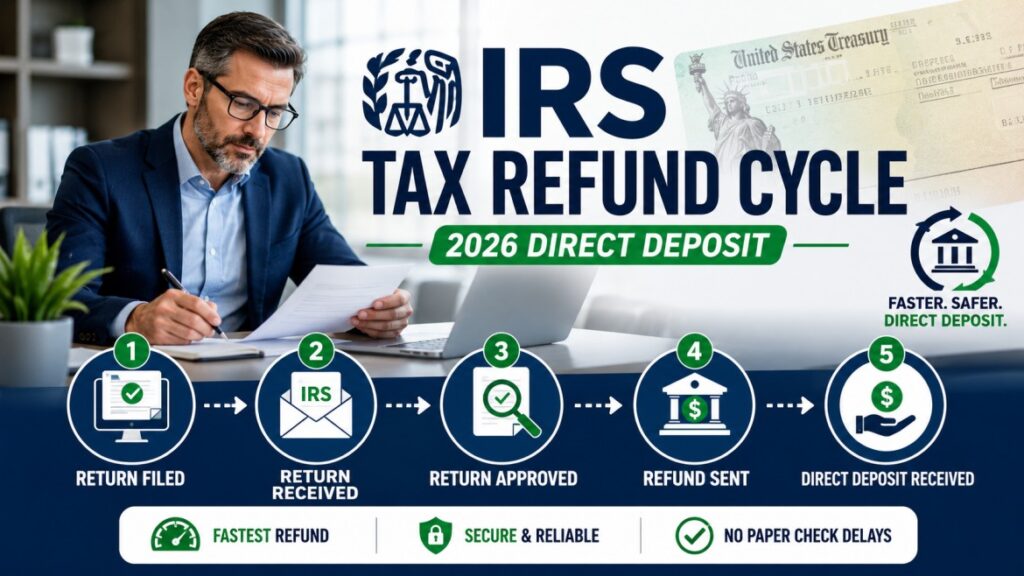
Because getting these funds quickly is vital, taxpayers naturally want to know when their money will land in their bank accounts. If you are waiting on your refund, you are likely looking for the official irs tax refund cycle chart 2026 direct deposit dates.
In this comprehensive guide, we will break down the expected direct deposit schedule, explain how to track your status using official IRS tools, detail the factors that can delay your payment, and outline the new rules governing rejected bank deposits.
Understanding the IRS Tax Refund Cycle Chart 2026 Direct Deposit Schedule
To clear up a common misconception: the IRS does not publish an official refund cycle chart. The agency processes millions of tax returns daily, and because every tax return is unique, they cannot guarantee an exact date for every taxpayer.
However, the IRS maintains a very consistent processing window. If you file your taxes electronically (e-file) and choose direct deposit, the IRS typically issues your refund in 21 days or less.
Based on historical data and the standard 21-day window, we have mapped out an estimated irs tax refund cycle chart 2026 direct deposit schedule to help you track your expected payment date:
| Date Your Return Was Accepted by IRS | Expected Direct Deposit Date (within 21 Days) | Expected Paper Check Mailing Date (within 6 Weeks) |
|---|---|---|
| Jan 26 – Feb 1, 2026 | February 13 – February 20, 2026 | March 6 – March 13, 2026 |
| Feb 2 – Feb 8, 2026 | February 20 – February 27, 2026 | March 13 – March 20, 2026 |
| Feb 9 – Feb 15, 2026 | February 27 – March 6, 2026 | March 20 – March 27, 2026 |
| Feb 16 – Feb 22, 2026 | March 6 – March 13, 2026 | March 27 – April 3, 2026 |
| Feb 23 – Mar 1, 2026 | March 13 – March 20, 2026 | April 3 – April 10, 2026 |
| Mar 2 – Mar 8, 2026 | March 20 – March 27, 2026 | April 10 – April 17, 2026 |
| Mar 9 – Mar 15, 2026 | March 27 – April 3, 2026 | April 17 – April 24, 2026 |
| Mar 16 – Mar 22, 2026 | April 3 – April 10, 2026 | April 24 – May 1, 2026 |
| Mar 23 – Mar 29, 2026 | April 10 – April 17, 2026 | May 1 – May 8, 2026 |
| Mar 30 – Apr 5, 2026 | April 17 – April 24, 2026 | May 8 – May 15, 2026 |
Note: This chart is an estimate. Mailed paper checks take significantly longer to process and deliver, usually taking 6 to 8 weeks from the date your return is accepted.
Key Factors That Can Delay Your Tax Refund
While the 21-day timeline holds true for the vast majority of e-filers, certain circumstances can delay your tax refund.
1. The PATH Act (EITC and ACTC Credits)
By federal law (the Protecting Americans from Tax Hikes, or PATH Act), the IRS cannot issue refunds on tax returns that claim the Earned Income Tax Credit (EITC) or the Additional Child Tax Credit (ACTC) before mid-February.
Even if you e-filed on the first day of tax season, the IRS holds your entire refund until they can verify the credit eligibility to prevent fraud. For these taxpayers, refunds are typically deposited into bank accounts starting in early March.
2. Manual Reviews and Errors
If your return contains errors, math mistakes, or missing information, it will be pulled from the automated system for a manual review by an IRS agent. This can extend your processing time from 21 days to several months. Common triggers include:
- Mismatched names or Social Security Numbers.
- Unreported income (failing to include a 1099 or W-2 form).
- Claiming credits you do not qualify for.
3. Identity Verification Letters (Letter 5071C)
To combat identity theft, the IRS randomly flags returns and mails a Letter 5071C to the taxpayer. If you receive this letter, your refund is placed on hold until you log online to the IRS portal or call the helpline to verify your identity. Once verified, it takes up to nine weeks for the IRS to release your direct deposit.
Critical 2026 Update: Rejected Direct Deposits
Historically, if the IRS attempted to send your refund via direct deposit and the transaction was rejected by your bank (due to a typo in the routing number or a closed account), the system would automatically mail a paper check.
Starting in 2026, this policy has changed: To prevent tax fraud and check intercept scams, the IRS now freezes most deposits that are rejected by financial institutions. Instead of an automatic paper check, the IRS will place a temporary hold on your funds and require you to log into your online account to verify your banking information and request a reissue.
IMPORTANT
Double-check your routing and account numbers before hitting submit on your tax software. A simple typo can delay your refund by weeks or months under the new 2026 rules.
Step-by-Step: How to Check Your Refund Status Online
If you want to bypass estimated schedules and get real-time status updates on your specific refund, use these official IRS tools:
Step 1: Use the “Where’s My Refund?” Tool
- Go to the official IRS website: irs.gov/refunds.
- Click on “Check Your Refund”.
- Input your Social Security Number (SSN) or Individual Taxpayer Identification Number (ITIN).
- Select your filing status (Single, Married Filing Jointly, Head of Household).
- Enter the exact whole-dollar amount of your expected refund.
- Submit the form to view your current status (Received, Approved, or Sent).
Step 2: Access Your IRS Tax Transcripts
If the “Where’s My Refund” tool is not updating, you can check your official account transcript:
- Log into your “IRS Online Account” at irs.gov.
- Navigate to “Tax Records” and click “Get Transcript”.
- Look for the current tax year transcript.
- Scroll to the bottom and check the transaction codes. Look for Code 846 (Refund Issued). The date listed next to Code 846 is the exact day the IRS will release your direct deposit.
Frequently Asked Questions (FAQs)
Does the IRS update the refund status daily?
Yes, the “Where’s My Refund?” database is updated once every 24 hours, usually overnight between midnight and 6:00 AM. There is no need to check the tool multiple times per day.
Why is my refund status still “Received” after 21 days?
If your status has not progressed to “Approved” after three weeks, your return is likely undergoing a manual review. Check your mail for any letters or notices from the IRS asking for additional documentation.
What does Tax Code 846 mean on my transcript?
Tax Code 846 stands for “Refund Issued.” It indicates that the IRS has approved your return, calculated your refund, and scheduled a direct deposit or paper check mailing date.
Can I change my direct deposit details after filing?
No. Once your return has been accepted by the IRS, you cannot change your direct deposit routing or account numbers. If you entered incorrect details, you must wait for the bank to reject the deposit and contact the IRS to resolve the issue.