Whether you are a newcomer to the sport or a casual viewer tuning in for a big tournament, understanding the timing of the game is essential. If you are planning your day around a broadcast, you might wonder how long is a soccer match including halftime? Unlike sports like American football or basketball that have frequent commercial breaks and time-outs, soccer runs on a continuous clock, making the overall broadcast time much more predictable.
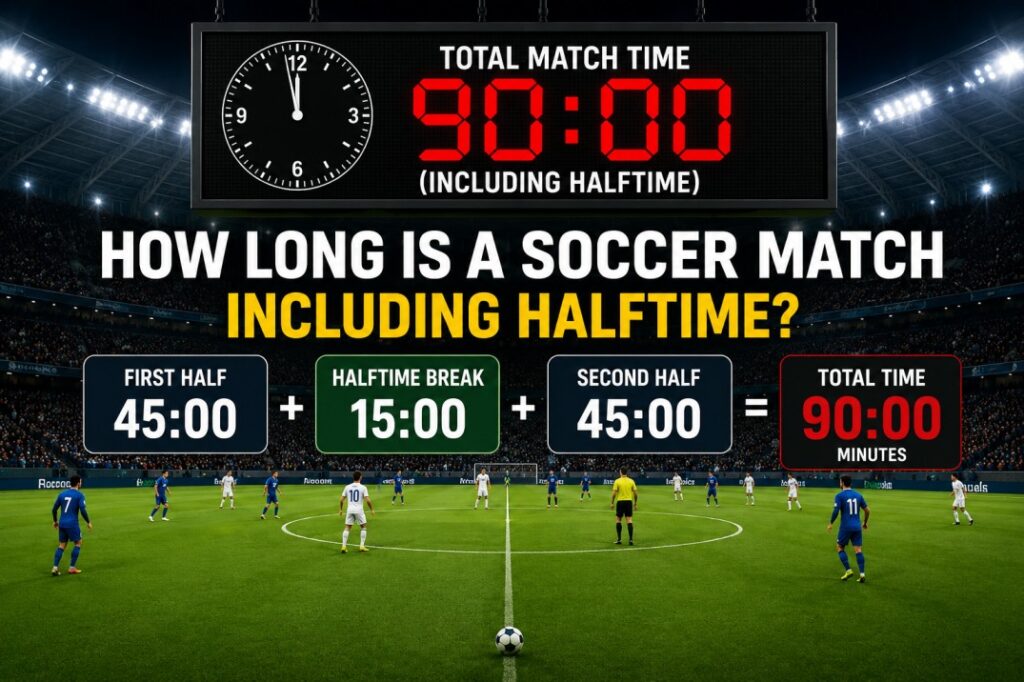
In professional soccer, a match lasts for a standard duration, but extra factors like stoppage time and overtime can extend the game.
In this comprehensive guide, we will break down exactly how long is a soccer match including halftime, explain the mechanics of stoppage time and extra time, analyze how soccer broadcast times compare to other major sports, compare match lengths across different age groups, and detail what to expect when tuning in to watch a game.
Understanding the Soccer Timing: How Long is a Soccer Match Including Halftime?
At the professional level, a standard soccer match is split into two halves of 45 minutes each, separated by a halftime break.
The halftime interval in professional matches lasts exactly 15 minutes.
Therefore, when you add the 90 minutes of active playing time and the 15-minute halftime break, a basic soccer match requires a minimum of 105 minutes of broadcast time. However, due to stoppage time added at the end of each half, you should plan to allocate at least 110 to 120 minutes (about 2 hours) to watch a standard game from kickoff to the final whistle.
Key Factors That Extend the Length of a Soccer Match
While the basic clock runs for 105 minutes, several factors regularly extend the duration of a match:
1. Stoppage Time (Injury Time)
Unlike sports where the clock stops when the ball goes out of play, a soccer referee’s clock never stops running. To account for lost time during the game, the head referee calculates “stoppage time” (also called added time or injury time) and adds it to the end of each 45-minute half.
Common causes of stoppage time include:
- Treatment and removal of injured players.
- Player substitutions.
- Goal celebrations.
- Time-wasting tactics by players.
- Video Assistant Referee (VAR) reviews.
Typically, the referee adds between 1 to 3 minutes at the end of the first half, and 3 to 6 minutes at the end of the second half, adding roughly 5 to 10 minutes of total time to the match.
This extra time is crucial during knockout stages, where teams must win to progress in the fifa world cup 2026 standings and points table
2. Extra Time (Overtime in Knockout Rounds)
In league matches (like the Premier League or MLS regular season), a match can end in a draw. However, in knockout tournaments (like the FIFA World Cup knockout stages or the UEFA Champions League), a winner must be decided.
If the score is tied after 90 minutes of regulation, the match enters Extra Time:
- Extra time consists of two halves of 15 minutes each (30 minutes total).
- There is a tiny 5-minute break between regulation and extra time, but no extended halftime.
- When you add regulation, halftime, and extra time, the total match duration increases to approximately 145 to 150 minutes (about 2.5 hours).
3. Penalty Shootouts
If the score remains tied after the 30 minutes of extra time, the game is decided by a penalty shootout. A penalty shootout involves five players from each team taking penalty kicks. This process takes an additional 10 to 15 minutes to complete.
The Modern Update: FIFA’s Stoppage Time Revolution
If you have watched recent international matches, you may have noticed games extending far past the standard 90 minutes. Starting with the FIFA World Cup in 2022 and continuing through to the 2026 World Cup, FIFA introduced a strict directive regarding time-wasting.
Previously, referees added a standard 3 to 4 minutes of stoppage time per half as a rough estimate. Under the new guidelines, referees are instructed to calculate lost time with extreme accuracy. Goal celebrations, substitutions, and injury treatments are timed down to the second.
As a result, it is now common to see 7 to 10 minutes of stoppage time added to the second half of matches. This means a standard soccer match without extra time can regularly push past the 120-minute mark (including halftime).
Broadcast Comparison: Soccer vs. Other Major American Sports
For American sports fans, the pacing of a soccer broadcast is a refreshing change. Because the game clock runs continuously and there are no commercial breaks during play, the total television broadcast window is highly predictable compared to the NFL, NBA, or MLB:
- Soccer: A 90-minute game takes roughly 2 hours to broadcast, including halftime and stoppage time.
- American Football (NFL): Despite having a 60-minute game clock, a standard NFL broadcast takes 3 hours and 12 minutes on average due to commercial breaks, reviews, and pauses between plays.
- Basketball (NBA): With a 48-minute game clock, an NBA broadcast takes approximately 2.5 hours due to time-outs and foul stoppages.
- Baseball (MLB): Even with the pitch clock rules, a standard MLB game runs for about 2 hours and 40 minutes.
This makes soccer one of the most time-efficient sports to watch, as viewers are guaranteed continuous action with a predictable end time.
How to Read a Stadium Clock During a Soccer Broadcast
If you are used to American sports like basketball or football, reading a soccer stadium clock can be confusing. Here are a few key differences to keep in mind:
- Counting Upward: Soccer clocks count upward from 0:00 to 45:00 in the first half, and from 45:00 to 90:00 in the second half, rather than counting down to zero.
- The Clock Does Not Stop at 90:00: The physical stadium clock will stop exactly at 90:00 (or 45:00 in the first half), but the game continues. The referee tracks the additional stoppage time on their personal wristwatch, and play continues until the referee blows the whistle.
- Tracking Stoppage Time on Screen: Most television networks will display a small “+” sign next to the 45:00 or 90:00 mark (e.g., 90:00 +5) to show viewers how much added time remains.
Soccer Match Length by Age Group & League
Not all soccer matches are 90 minutes long. Youth leagues, high school tournaments, and college matches have different durations to accommodate the physical capabilities of the players:
| League / Age Group | Half Length (Minutes) | Halftime Length (Minutes) | Total Match Time (Including Halftime) |
|---|---|---|---|
| Professional (FIFA/MLS) | 45 | 15 | 105 Minutes |
| NCAA College Soccer | 45 | 15 | 105 Minutes |
| High School (NFHS) | 40 | 10 | 90 Minutes |
| Youth U15 – U19 | 40 | 10 | 90 Minutes |
| Youth U13 – U14 | 35 | 10 | 80 Minutes |
| Youth U11 – U12 | 30 | 10 | 70 Minutes |
| Youth U9 – U10 | 25 | 10 | 60 Minutes |
| Youth U8 & Under | 20 | 5 | 45 Minutes |
Note: In youth leagues, there is no extra time or stoppage time. The referee stops the clock only under extreme circumstances, making youth matches much shorter and easier to schedule.
Frequently Asked Questions (FAQs)
How long is a soccer match including halftime?
A professional soccer match lasts 105 minutes in total, which includes two 45-minute halves and a 15-minute halftime interval. With added stoppage time, a standard game takes about 110 to 115 minutes to complete.
How long is halftime in soccer?
For professional and college matches, halftime lasts exactly 15 minutes. In high school and younger youth leagues, halftime is usually shortened to 10 minutes (and 5 minutes for U8 leagues).
Is there overtime in regular soccer matches?
In standard league play, there is no overtime; if the score is tied after 90 minutes plus stoppage time, the match ends in a draw. Overtime (extra time) is only used in tournament knockout matches.
Does the clock stop when a player is injured?
No. The stadium clock and referee’s clock run continuously. The referee tracks the time lost due to injuries and adds it as stoppage time at the very end of the half.